
5 Signs Your Appliance Needs Professional Repair (Not DIY)
Repairly Team · · 7 min read · Updated
In this article
- 1. Burning Smells or Visible Sparks
- 2. A Gas Odor Around Your Range or Cooktop
- 3. Your Appliance Keeps Tripping the Breaker
- 4. Persistent Water Leaks From Your Refrigerator
- 5. It Still Runs — But Something Has Changed
- Two more reasons to call a pro — even for a “fixable” problem
- What happens when you do call a professional
Some appliance problems are perfect for a weekend fix. Others are warning signs that mean you should put the tools down and pick up the phone. Knowing when to call an appliance repair professional protects your home, your safety, and your wallet — because a small misjudgment with a gas range or an electrical fault can turn a cheap fix into a dangerous one. We’ve walked into plenty of kitchens where a DIY attempt made a one hour repair into a much bigger one. Here are five clear signs the job has moved past DIY — and what you can still safely check yourself before calling.
1. Burning Smells or Visible Sparks
A burning odor or sparks from your refrigerator, wall oven, cooktop, range, or dryer almost always points to an electrical fault — frayed wiring, a failing motor, or a shorting component. These aren’t cosmetic issues; they’re fire risks.
If you see sparks or smell burning:
- Stop using the appliance immediately.
- Unplug it, or switch off the breaker if it’s hardwired.
- Do not try to reset it and “see if it happens again.”
One nuance worth knowing: a brief “hot dust” smell the first time you run an oven after months of disuse is common and usually harmless. A burning plastic or electrical smell is a different animal — that one means stop.
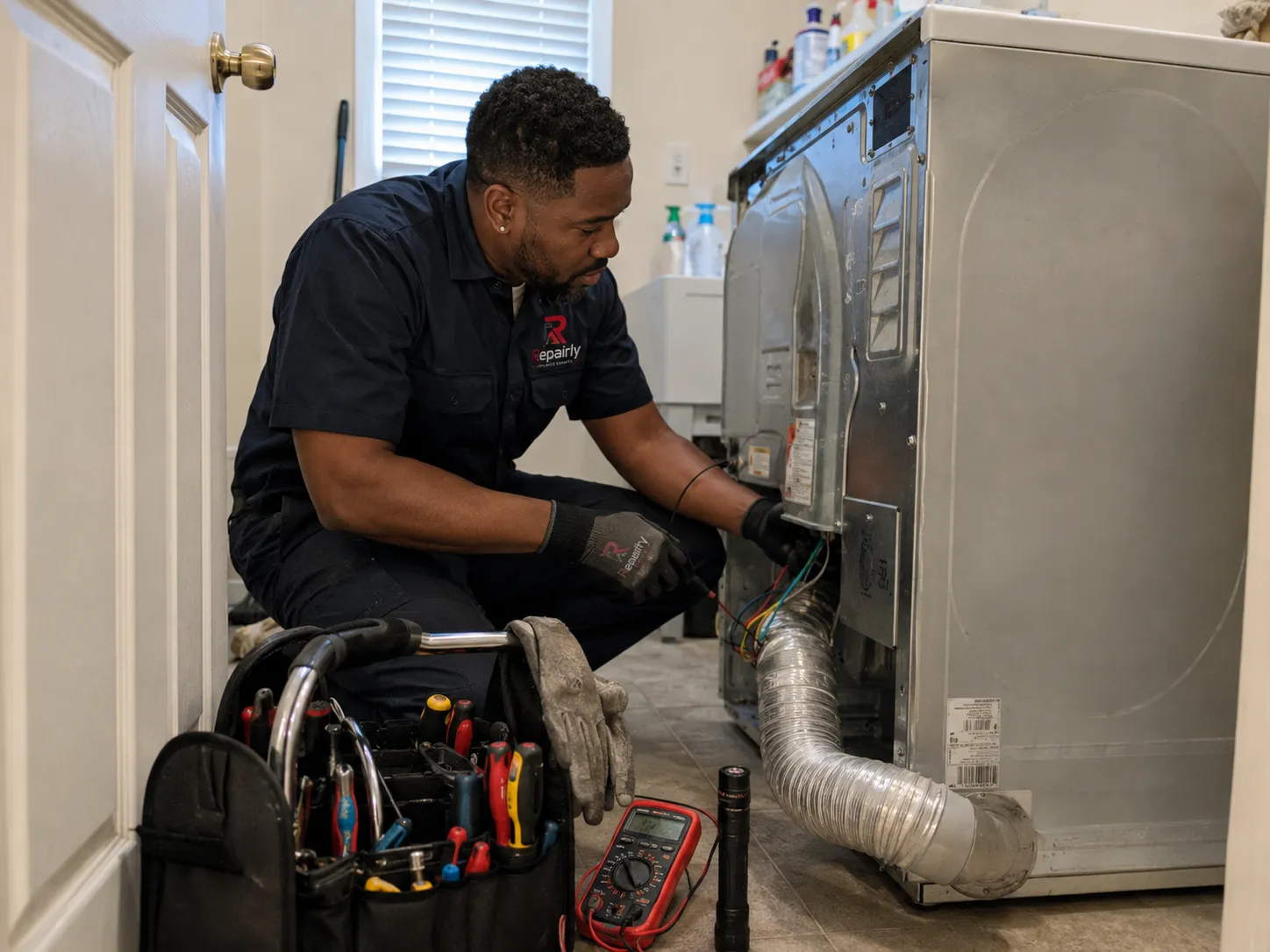
Dryers deserve special attention here, since lint buildup plus heat is a fire hazard the Consumer Product Safety Commission has flagged for years. Cleaning the lint screen is your job; what you can’t see is the lint packed inside the cabinet and the vent duct behind the machine. A pro handling professional dryer repair opens the unit, clears the hidden buildup, finds the fault, and confirms the machine is safe to run again.
2. A Gas Odor Around Your Range or Cooktop
If you ever smell gas near your range or cooktop, treat it as an emergency — not a repair project. Natural gas leaks are dangerous and can ignite from the smallest spark.
Do this first:
- Don’t flip switches, light a match, or use anything that could create a spark — including your phone indoors.
- Open windows and doors to ventilate if you can do so quickly.
- Get everyone out and, from a safe distance, call your gas company or 911.
Only after the leak is confirmed handled should you think about repair. When it’s time to fix the source — a bad valve, igniter, or connection — that’s a job for a qualified professional, not a DIY afternoon.
One thing that is normal: a few clicks before a burner lights. Continuous clicking after the flame is lit, or clicking with no flame at all, usually means a wet, dirty, or misaligned igniter — annoying but not an emergency, and a quick professional fix. The distinction is smell. Clicking without gas odor is a service call; any gas odor is 911-first.
3. Your Appliance Keeps Tripping the Breaker
A breaker trips to protect you. If your appliance trips it once, that can be a fluke. If it trips repeatedly, something inside is drawing too much current — a shorted compressor, a failing heating element, or damaged wiring.
Resetting the breaker again and again doesn’t fix anything; it just invites overheating. Unplug the appliance and leave the circuit off until a technician can diagnose the real cause.
The safe check first: make sure the appliance is actually the culprit. If the circuit feeds several outlets, unplug everything else on it and see whether the breaker holds. In older LA housing stock — and this city has a lot of it — kitchens sometimes run on wiring that predates modern appliance loads, so the problem is occasionally the circuit, not the machine. Either way, the diagnosis involves measuring live current draw, and guessing at electrical faults is exactly where DIY goes wrong.
There’s an electric dryer cousin of this problem worth knowing: a dryer that tumbles but never heats may have lost half of its 240-volt supply — one leg of the circuit — which looks like a broken dryer but is really an electrical supply fault. That’s a five minute diagnosis with a meter and a dangerous afternoon without one.
4. Persistent Water Leaks From Your Refrigerator
A puddle under your fridge might be a simple clogged defrost drain — or it might be a cracked water line, a failing valve, or a problem behind the unit you can’t see. A little troubleshooting is fair game: unplug the refrigerator first, then check for an obvious blocked drain or a loose water line connection.
But if the leak keeps coming back after you’ve done the basics, stop there. Here’s why chasing it blindly goes wrong: the visible puddle is the end of the water’s path, not the source. Water from a failed defrost system can travel under the liner and appear somewhere else entirely, and meltwater near the fridge’s electrical components is a combination best left to a pro. Meanwhile the slow damage adds up — warped flooring and swollen cabinet bases cost far more than the repair that would have prevented them.
A technician will trace the actual source, clear or repair it, and — just as important — verify the fix by running the system through a full cycle instead of declaring victory when the floor looks dry.
5. It Still Runs — But Something Has Changed
The most missed sign isn’t a dramatic failure. It’s a working appliance that has started behaving differently: the fridge running constantly instead of cycling, a new grinding or buzzing you’d never heard before, bake times drifting longer, a dryer needing two cycles where one used to do.
Appliances rarely fail without warning. A compressor that runs flat out is compensating for something — a fan, a coil, low refrigerant. An oven that drifts is telling you a sensor or element is on its way out. Catching the fault at the “something’s different” stage is routinely the difference between a modest repair and a major one, because the compensating component is wearing itself out covering for the failing one.
The safe checks first: for a hard working fridge, make sure the condenser coils aren’t caked in dust and the door gaskets seal (our guide to cleaning refrigerator condenser coils covers the coil job). For a slow dryer, clear the lint path. If the symptom survives those basics, it’s diagnostic time — and worth doing before the small fault takes the big component with it.
Two more reasons to call a pro — even for a “fixable” problem
It’s Still Under Warranty
If your appliance is under manufacturer or extended warranty, opening it yourself can void that coverage. Check your paperwork before you touch anything — an authorized repair keeps your protection intact. (For appliances out of manufacturer warranty, any competent independent shop can take over.)
Age vs. Repair Cost
There’s a point where repeated repairs stop making sense on an aging appliance. The rule of thumb we use on every call: if the unit is under 10–12 years old and the repair costs well under half of a comparable new one, repair usually wins. An old machine with a failed major component usually doesn’t justify it — and a good technician will tell you that before you spend anything, not after. Get a written estimate and an honest assessment, then decide.
What happens when you do call a professional
So you’ve hit one of the five signs. Here’s what a well run service call looks like, so you know what to expect — and what to demand.
You describe the symptom, you get a real arrival window, and the technician shows up equipped: meters for the electrical faults, manifold gauges for sealed system work, and common OEM parts stocked on the truck so most repairs finish in one visit. You get a written estimate before any work begins, you approve the price, and the repair carries a warranty on both parts and labor — ours runs a full year.
That last part matters more than it sounds. A company that stands behind its repair for a year has no incentive to patch the symptom and hope; the fix has to hold.
When any of these five signs show up, don’t gamble on a DIY fix. Repairly handles appliance repair across Los Angeles for refrigerators, wall ovens, cooktops, ranges, and dryers — background checked, trained technicians. Book online or call (818) 282-6145 and let a professional handle it safely.
Repairly Team
Expert appliance repair technicians serving Los Angeles homeowners.
Related Articles
Ready to book?
Appliance repair in Los Angeles, backed by warranty
Call or book online, and we'll confirm your visit time by phone.